Operating Models for Multi-Region Companies
Introduction
Companies that operate across multiple geographic regions face a unique set of structural and strategic challenges. Differences in regulatory environments, customer expectations, talent availability, cultural norms, infrastructure maturity, and economic conditions require organizations to adopt operating models that balance global consistency with local flexibility.
An effective operating model for multi-region companies ensures that leadership alignment, governance frameworks, technology systems, and decision-making processes support both global objectives and regional performance. Without a clearly defined structure, organizations often experience duplication of effort, inconsistent execution, delayed decisions, and inefficient resource allocation.
This article explores the major operating model structures used by multi-region companies, explains how they function, and outlines best practices for designing a model that supports sustainable international growth.
What Is an Operating Model in a Multi-Region Context
An operating model defines how a company organizes its people, processes, governance, technology, and decision rights to deliver value across geographic markets.
For companies operating internationally, the operating model determines:
- How headquarters interacts with regional teams
- Where decision-making authority resides
- How resources are distributed
- How strategy translates into execution across regions
- How performance accountability is structured
A well-designed multi-region operating model ensures alignment between global priorities and regional realities.
Why Multi-Region Companies Need Structured Operating Models
Operating across borders introduces complexity that cannot be handled through informal coordination alone. Structured operating models help organizations manage:
Regulatory Differences
Each country may have different compliance standards, taxation frameworks, labor laws, and reporting requirements.
Customer Expectations
Products or services successful in one region may require adaptation elsewhere.
Operational Scalability
Growth across regions requires repeatable systems rather than isolated market-specific solutions.
Risk Exposure
Political risk, currency volatility, supply chain instability, and legal environments differ by geography.
A structured operating model ensures resilience and consistency while supporting regional responsiveness.
Core Types of Operating Models for Multi-Region Companies
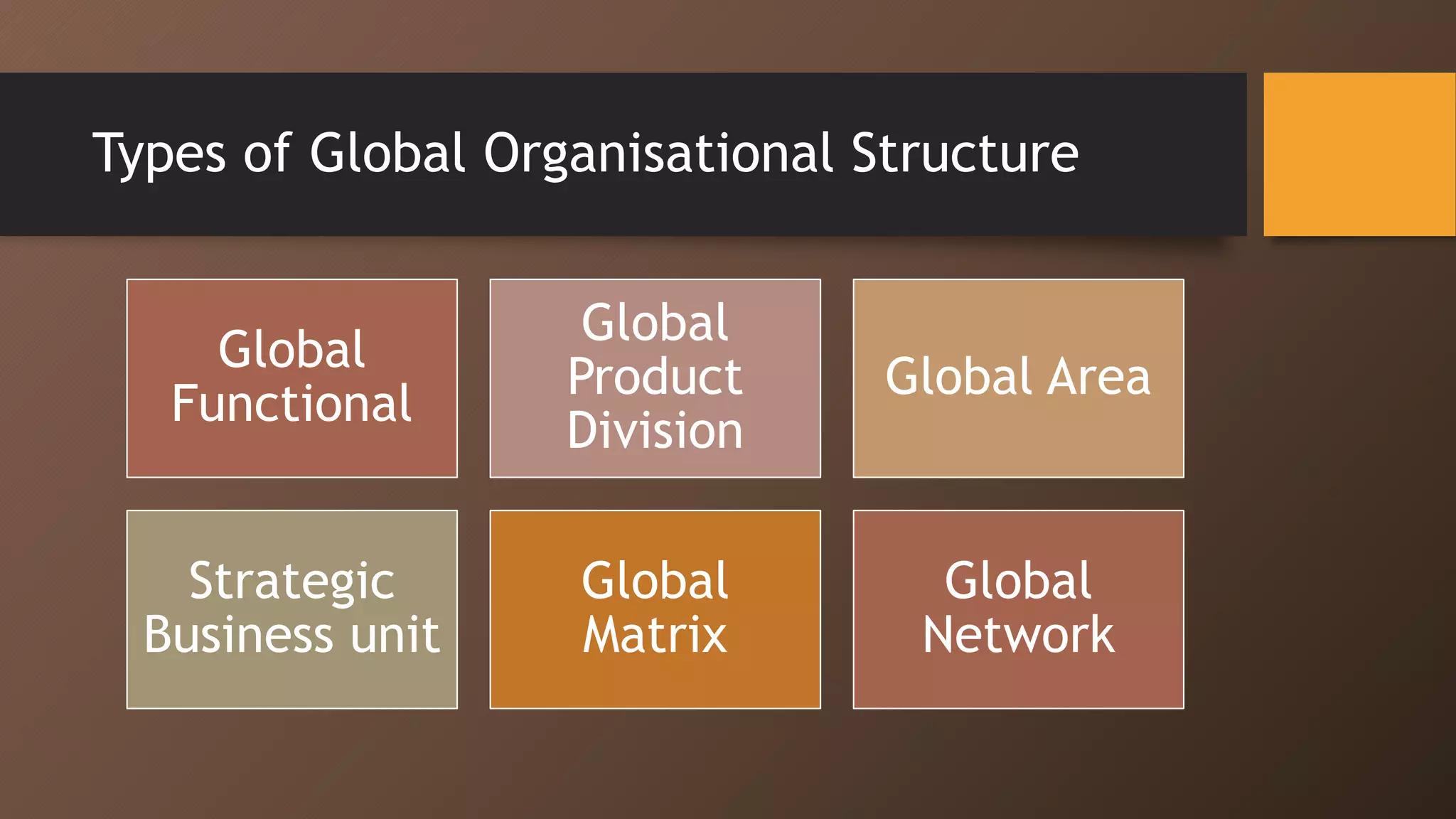
Most multinational organizations adopt one of four primary operating structures depending on their strategy, maturity level, and market complexity.
Global Centralized Model
In this structure, strategic decisions and operational control remain primarily at headquarters.
Regional offices function mainly as execution arms rather than independent decision-making entities.
Key characteristics include:
- Centralized product development
- Unified branding and messaging
- Standardized processes
- Strong headquarters oversight
- Limited regional autonomy
This model works well for organizations prioritizing brand consistency and operational efficiency across markets.
Best suited for:
- Technology companies
- Luxury brands
- Manufacturing firms with standardized production
- Early-stage international expansion
However, excessive centralization can reduce responsiveness to local market needs.
Regional Hub Model
The regional hub model creates intermediate leadership layers between headquarters and local country teams.
Regional headquarters oversee clusters of markets such as:
- North America
- Europe
- Asia-Pacific
- Middle East and Africa
- Latin America
Regional leaders adapt global strategy to local realities while maintaining alignment with corporate objectives.
Advantages include:
- Faster decision-making
- Cultural alignment with markets
- Regulatory responsiveness
- Improved coordination across nearby countries
This model balances global oversight with regional flexibility.
Multi-Domestic Model
The multi-domestic structure gives significant autonomy to individual country teams.
Each market operates almost independently while following high-level corporate guidance.
Key features include:
- Localized product strategies
- Country-specific marketing
- Independent pricing structures
- Decentralized leadership authority
This model works well in industries where consumer behavior differs significantly across regions.
Examples include:
- Retail
- Food and beverage
- Telecommunications
- Media and entertainment
While this model increases adaptability, it can create inefficiencies through duplication of resources.
Matrix Operating Model
The matrix model combines functional leadership with regional accountability.
Employees often report to both:
- A functional leader
- A geographic leader
For example, a marketing director in Europe may report to both the global marketing head and the regional managing director.
Benefits include:
- Cross-functional collaboration
- Strong knowledge sharing
- Balanced authority structures
- Better global alignment
However, matrix models require strong governance and communication to avoid confusion over decision rights.
Key Components of an Effective Multi-Region Operating Model
Successful international organizations design operating models around several foundational elements.
Governance Structure
Governance defines how decisions move across the organization.
Effective governance clarifies:
- Strategic ownership
- Budget authority
- Regional accountability
- Risk management responsibilities
Clear governance prevents duplication and conflict between headquarters and regional teams.
Decision Rights Framework
Companies must determine which decisions belong at:
- Global level
- Regional level
- Country level
Typical examples include:
Global decisions
- Brand identity
- Technology architecture
- Financial reporting standards
Regional decisions
- Market entry prioritization
- Resource allocation within clusters
- Regional partnerships
Country decisions
- Local marketing campaigns
- Vendor selection
- Hiring execution
Clarity here improves speed and accountability.
Technology Infrastructure
Technology plays a central role in aligning multi-region operations.
Organizations typically rely on shared platforms for:
- Finance systems
- Customer relationship management
- Data analytics
- Supply chain visibility
- Workforce collaboration
Standardized systems ensure transparency across markets.
Talent Strategy
People structures must reflect geographic complexity.
High-performing global organizations invest in:
- Regional leadership development
- Cross-border assignments
- Cultural intelligence training
- Mobility programs
- Local hiring strategies
Talent alignment strengthens execution consistency.
Performance Measurement Systems
Multi-region companies require balanced performance frameworks.
Metrics typically include:
- Regional revenue growth
- Market share performance
- Customer satisfaction
- Operational efficiency
- Compliance indicators
Balanced scorecards prevent short-term decision bias toward individual markets.
Choosing the Right Operating Model for Your Organization
No single structure fits every organization.
The right operating model depends on multiple factors.
Industry Characteristics
Industries with standardized products often benefit from centralized structures.
Industries with strong local customer variation require decentralized models.
Market Maturity Levels
Companies operating in emerging markets may need stronger regional flexibility than those in mature markets.
Organizational Size
Large multinational organizations typically benefit from layered regional structures.
Smaller companies expanding internationally may begin with centralized coordination.
Growth Strategy
Companies pursuing acquisitions often adopt matrix or hybrid structures.
Companies expanding organically may begin with regional hubs.
Hybrid Operating Models in Modern Global Organizations
Many successful companies adopt hybrid operating models rather than relying on a single structure.
Hybrid models combine:
- Centralized strategy
- Regional coordination
- Local execution flexibility
For example:
Global headquarters may control product development while regional teams control customer engagement strategy.
Hybrid models allow organizations to maintain brand consistency while responding effectively to regional differences.
Challenges Multi-Region Companies Face When Designing Operating Models
Even well-planned structures encounter operational friction.
Common challenges include:
Decision Delays
Unclear authority structures slow execution.
Role Overlap
Matrix structures sometimes create confusion over accountability.
Cultural Misalignment
Global strategy may conflict with regional expectations.
Technology Fragmentation
Different systems across regions reduce visibility.
Resource Duplication
Independent regional initiatives can increase operational costs.
Organizations that proactively address these issues maintain stronger alignment across markets.
Best Practices for Implementing Multi-Region Operating Models
Successful implementation requires more than organizational charts.
Companies should follow structured rollout strategies.
Align Strategy Before Structure
Operating models should support long-term objectives rather than react to short-term operational pressures.
Define Accountability Clearly
Each region should understand its authority boundaries.
Standardize Core Processes
Consistency across finance, compliance, and reporting improves transparency.
Invest in Leadership Communication
Regular cross-region coordination strengthens execution quality.
Build Shared Data Platforms
Integrated analytics improve visibility and decision speed.
Review Structure Regularly
Operating models should evolve alongside market expansion and organizational maturity.
Continuous refinement ensures long-term effectiveness.
The Role of Digital Transformation in Multi-Region Operating Models
Digital transformation is reshaping how global organizations structure operations.
Cloud-based platforms enable:
- Real-time collaboration
- Centralized reporting
- Distributed workforce management
- Faster market entry
- Remote leadership coordination
Organizations that integrate digital infrastructure into their operating models achieve stronger global alignment and improved scalability.
Technology now serves as the backbone of modern multinational coordination.
Future Trends in Multi-Region Operating Models
Several trends are influencing how global companies structure their operations.
Regional Empowerment
Organizations increasingly decentralize execution authority while maintaining strategic oversight.
Data-Driven Decision Models
Analytics platforms support faster cross-market insights.
Agile Regional Teams
Flexible regional structures allow rapid response to changing conditions.
Distributed Leadership Models
Leadership responsibilities are becoming more geographically balanced rather than headquarters-centric.
Companies that adapt to these trends strengthen competitiveness across markets.
FAQ Section
What is the difference between a global operating model and a regional operating model
A global operating model centralizes decision-making at headquarters, while a regional operating model distributes authority to regional leadership teams responsible for clusters of countries.
How do companies decide whether to centralize or decentralize operations
Organizations evaluate product standardization requirements, customer behavior differences, regulatory complexity, and strategic priorities before selecting their structure.
Can companies combine multiple operating models at the same time
Yes. Many multinational companies use hybrid structures that centralize strategy while decentralizing execution responsibilities across regions.
What role does culture play in multi-region operating models
Cultural alignment improves communication, strengthens leadership effectiveness, and ensures strategies are implemented appropriately across different markets.
How often should companies review their operating models
Organizations typically reassess their operating structures during major expansion phases, mergers, digital transformation initiatives, or shifts in strategic direction.
Do smaller companies need regional operating models
Smaller companies entering international markets often begin with centralized structures but gradually adopt regional coordination as operations expand.
How does digital transformation improve multi-region coordination
Digital platforms enable shared reporting systems, real-time collaboration tools, centralized analytics dashboards, and integrated workflow management across global teams.
If you’d like, I can also produce a second version tailored specifically for consulting audiences, enterprise executives, or MBA-level readers. 📊